Showing posts with label communication. Show all posts

Thursday, February 4, 2016

Coming Soon By PIE!!! The SRRD (Self Recording Raudive Diode)


Coming next month by PIE the SRRD!!! This piece of equipment is a Raudive Diode that records without having to plug it into any recorder or other device. The way this item works: it has its own internal 8gb storage, it also has its own rechargeable battery. With a full charge it will run and record for 15 hours, it has a on/off switch, led light (to show when its recording, when it was shut off, low battery and charging). Its easy to upload the files it records to the computer via USB (that is also the way it charges). Basically you just turn it on and continue your investigation. It is small enough to either be hand held or just sit on a table when doing an EVP session. I also build a basic Raudive Diode that plugs into a recorder. If your not familiar with the Raudive Diode or have questions about how it works, email me at info@paranormalinvestigationsequipment.com, contact me from my website or message me on Facebook.

PIE's SRRD

Tuesday, October 13, 2015

Redesigned piece of old school equipment from Paranormal Investigations Equipment

Matt here from Paranormal Investigations Equipment, I have redesigned a piece of old school equipment.

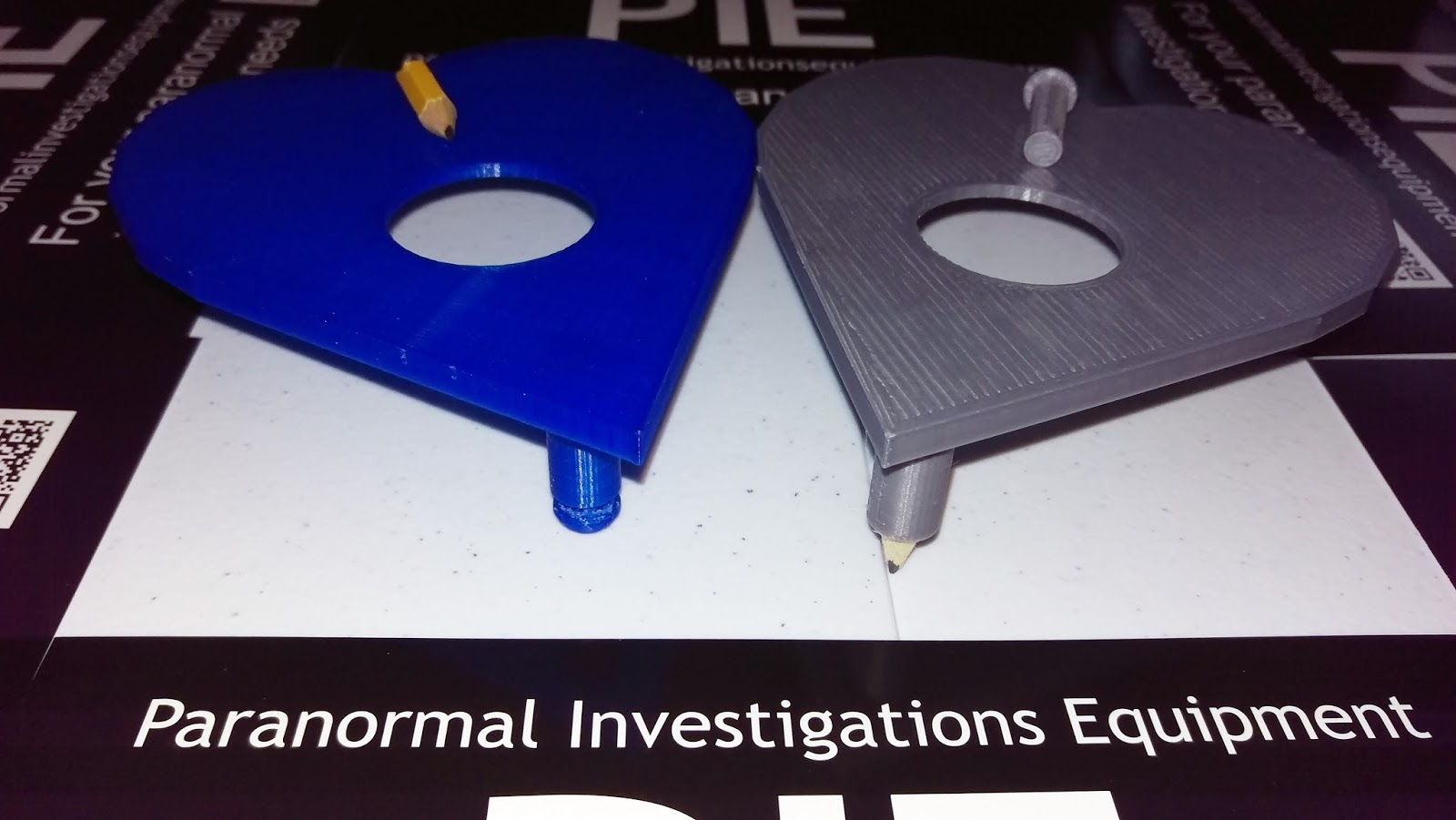
The Auto-Write Planchette

The Auto-Write Planchette has been around since the middle 1800's, but has not been widely used as an ITC tool. I am trying to change that, this device does not need a spirit board to accompany it as is the assumption of many people. Yes the planchette IS used with spirit boards, but the Auto-Write Planchette only needs a piece of paper for the spirit or entity being spoken too, to write out it's answers. I have however redesigned this Auto-Write Planchette to be used as a normal planchette as well. By removing the front leg and replacing it with a pencil this ITC device can be used for either a normal planchette or an Auto-Write Planchette. 

Wednesday, May 6, 2015

How to Stop Cell Phones From Interfering With Audio Equipment

Yesterday I stated that blackberry buzz, or GSM buzz, doesn’t happen much anymore. Apparently, it does. Thanks to those who emailed.
GSM buzz is an audible interaction between some cellphones and audio equipment. Dusting off my onomatopoeia skills, GSM sounds something like blip blip blip bzzzzzzz.
Whether it is a form of intentional or unintentional interference probably doesn’t matter to you. It is still interference and must be controlled.
I’m going to approach this in reverse order. First, let’s discuss how to get rid of it. Then, for those still interested, where it comes from.

How to Prevent Cell Phones From Interfering With Audio Equipment


Turn off cell phones

DUH, right? Well, it’s still the first line of defence against GSM buzz, which can’t happen if the cellphone’s transmitter is powered down.

Keep phones away from audio gear

Stages are carpeted in audio gear. The farther mobile phones are away from this equipment AND (very important) their cabling, the less likely they are to interfere. Most good engineers seem to impose an effective but draconian policy on talent: absolutely no cell phones anywhere on stage or off stage. All personal electronics are to be left in the green room, no exceptions, and all those in violation, famous or not, are chastised. Engineers everywhere would be wise to adopt similar policies.

Choke inputs for RFI

If you cannot power down or remove cell phones, cannot control or predict whether phones will be near audio equipment, or just want an additional layer of security, a superb way to reduce or eliminate GSM interference is to add a ferrite core before a cable input. Ferrite cores, or beads, filter RFI (radio frequency interference) collected by a cable unintentionally acting as an antenna, while allowing audio signal to pass through. Here’s what a simple one looks like, courtesy "Omegatron":
When it comes to GSM buzz, not just any ferrite core will do. You must use one that has the correct number of turns and is made from material optimized for attenuating high frequency GSM signal, which can be anywhere from 800 MHz to 1800 MHz.
For wireless audio, GSM buzz seems to be more of a problem with cell phones in close proximity to mic and intercom belt packs. In some cases it may enter these devices via the cable connecting lavalier or headset to beltpack. Ferrite cores should be placed at the audio cable input between headset and pack or lavalier and pack on wireless mic beltpack transmitters and intercom belt packs. The best chokes for pro audio are manufactured by Fair-Rite and snap around a cable. The correct size for lav cabling can be purchased from Mouser as part No. 623-0461178181 . The smallest cable outer diameter that this core will fit is 4.3 mm, so, if your lav cable is thinner than that you’ll need to roll some gaff tape or place additional insulation around the cable at the location where the core is placed to ensure a snug fit.
Cable of any kind is a likely entry point for GSM buzz, connecting many different kinds of devices. For standard XLR cables with outer diameters of about 9.5 mm, Mouser No. 623-0461167281should work, placed anywhere an XLR cable connects to mixers, amplifiers, or rack equipment.
There are other diameter snap-on chokes available but make sure whichever you choose is tuned for high frequencies. The mysteriously named Fair-Rite “Material 61” seems to be the best match for GSM buzz. Other types of ferrite chokes and XLR connectors are not optimized for high frequencies and may not provide much protection against cell phone buzz. You can read more about the theory behind ferrite core suppression and Material 61 here.

What Causes GSM buzz?


This was not an easy question to answer. The internet is in wide disagreement on the subject.
I reached out to the always knowledgable Henry Cohen, RF Design Engineer at CP Communications.
“GSM “buzz” occurs with GSM (TDMA) phones,” he said. “It is when the phone is communicating with the tower on the GSM control channel, which is not power regulated and can be as high 1 watt, depending on the phone model. It is pulsed data bursts and does not happen on the LTE side (the reason CDMA phones remain relatively quiet).”
Phones using GSM standards cause most buzzing. Phones using LTE and CDMA rarely do. GSM networks are less common than they used to be, but are still ubiquitous, and even non-GSM phones may “step down” to other networks for various reasons.
The problem is not that GSM mobile phones are using the same frequencies as wireless audio equipment. GSM networks operate hundreds of megahertz above the top of the UHF broadcast band.
The interference is caused by the rapid rate of on/off signaling between phone and base station at cellular frequencies. If these “pulsed data bursts” are able to leak into the audio signal path, they are rectified by electronic components within the device, often by the first amplifier they encounter, which introduces false voltages at audio frequencies into the signal and, down the line, into audible interference when the signal is converted into audio by a speaker.
If GSM pulsed data bursts do not have an opportunity to enter the signal path, they will not be falsely detected as audio by any of the device’s components. That’s why ferrite cores are effective: they filter out GSM frequencies, and the on/off bursts never make it to the non-linear stages where their patterns are unintentionally converted to audio.
These bursts exist in the form of electromagnetic waves in close-proximity (what we call the "near-field") to the phone. They enter wherever wires or metals offer them the chance to do so. The most common entry points are lengths of unshielded cable, which act as antennas (gathering radio energy), damaged shielded cable, connectors, PCB boards, or practically anything made from metal that somewhere intersects with the audio signal path.
Correctly shielded and grounded electronics, Henry asserts, are good at protecting audio from GSM buzz.
“The real issue is how audio equipment is designed to handle this radio interference. Properly designed and manufactured audio equipment that complies with AES standard 48 is quite immune to the GSM buzz.”
Cheap or poorly designed electronics are more likely to catch the buzz.
There is also a known gateway in XLR shielding called the shield current induced (SCIN) effect.


Saturday, March 14, 2015

AN EXPLANATION OF GHOST BOX COMMUNICATION

Ghost Box Communication Explained

by Bruce Halliday
LSC (Live Spirit Communication) is the practice of using a device known as a “Box” or “Ghost Box” to facilitate real time, Live Spirit Communication between the researcher and a non physical entity, presumably the spirits of disembodied human beings.
The “Box” is merely a device that enables the reception of radio signals and dices them up into small bits and pieces or fragments of sound by sweeping the chosen band at a fast enough rate so that the dial does not stop on any one station.
This prevents ghost boxes from delivering any whole or solid words of radio broadcast. This broken down signal is in turn broadcast through the boxes speaker thereby allowing the entity to use the fragments of sound for the purpose of communication enabling him or her to be heard live by the researcher as they communicate and also to have the communication not being heard live to be recorded by the communicator performing the session.
The theory is that an entity will use whatever bits of radio fragments it needs to form words and sentences. Through years of research I have come to a theory that the communication is formed as the sound leaves the speaker or the headphones respectively. That is what allows us to hear the responses in real time.
LSC/Ghost box communication should never be mistaken for traditional EVP is very simple in theory it only incorporates a recorder and a willing spirit. The theory is that the spirit uses the raw energy in the surrounding area of the recorder to form words and place them directly onto the recording media. I did traditional EVP in the field for 8 years and only gleaned about ten quality A+ EVP’s the rest were static whispers that had to be edited to death just to hear if there was something there.
With LSC there is some editing to be done but it all revolves around getting rid of the unwanted garbage sounds that are not utilized by the communicating entity and are merely a byproduct of the boxes sweep thus leaving only the communication, some files of communication may also have the playback speed slowed a bit due to the affect that a fast box sweep will deliver rapid communication that may be hard to understand by the laymen listening to the file, the volume can also be altered to a certain degree so that a very low communication or the opposite, a very loud communication can be adjusted to a comfortable listening level. This process does not alter, add or subtract anything to or from the spirit communication contained within the file.
With the boxes I personally am averaging about 25 to 30% hearing of real time messages, the rest are heard when reviewing the recording.
A Ghost box sweeps at a fast rate so it takes time to develop a skill for hearing the real time communication the novice will immediately start to hear the “yes” and “no” type of answers and even a “name” as the entities attempt to communicate.
New communicators do not hear much in real time at the beginning, hearing spirit communication live during a ghost box session takes some experience, there is a learning and development curve.
Most if not all new Ghost Box Communicators will have to develop what we experienced LSC veterans call “An Ear For the communication” this means only that the longer you practice LSC the more attuned your hearing will become to recognizing and hearing spirit communication live during a session. It is like a piano tuner, an apprentice will have to tune the piano using aids like a tuning fork but the seasoned piano tuner will be able to basically tune by ear just listening to the notes and knowing when they are correct. Same principle!
Box communication is ideal for both stationary research performed in a controlled environment and also field research conducted by Paranormal investigators on location.
There are a number of various boxes in use today, these boxes include of course the various radio shack and other hack boxes the paranormal puck and various models of the Mini Boxes also periodically an original Frank’s or Joe’s Box.
I would like to clear up a misnomer: quite a few individuals that become interested in the field of LSC are mistakenly calling Ghost boxes “Frank’s Boxes” The Frank’s Box was the original model of ghost box and there is only 13 individuals in the world that own them of which I have 2, they are antiquated and obsolete. The boxes that these new individuals are referring to are hack boxes and they are mistakenly calling them a Frank’s box. Just wanted to clear that up!
Most of these boxes are not being used by the majority of paranormal investigators and researchers, the older boxes such as the original Frank’s box and the Joe’s box are antiquated and are only used sporadically by a couple of researchers that are doing controlled research myself included.
The main boxes in use today are a couple of the hack boxes, the “Radio Shack 12-469″ which was readily available to most until Radio Shack discontinued it recently. And now the “Jensen SAB-55″ seems to have taken the place of the RS 12-469 as the popular go to box for most communicators and investigators today.
There are a couple of more popular hacks being used such as the Radio Shack hack 20-125 which was my box of choice before I created the Jensen SAB-55, the 20-125 sadly has also been put on the chopping block by Radio Shack. There have been a couple of other RS hacks recently but they have not caught on do to inherent flaws of lack of performance.
This information is the meat and potatoes of LSC/Ghost Box Communication please feel free to use any or all the information, my main goal in this field is to further the communication between our world and our friends in the spirit world and to distribute correct and positive information about the communication and its technology.

www.paranormalinvestigationsequipment.com